From cement to garden, by hand
From a bag of dry cement to a piece in your garden — what happens in between, why it takes the time it takes, and why a hand-cast Australian piece sits at the price it does.
If you're going to spend the money, see the work.
There are cheaper concrete statues than ours. Most are pressed at scale in factories overseas — that's a legitimate way to make a garden ornament and many of them look fine.
This page is for the customer asking the other question: why is the local one priced where it is? The short answer is the next eight scrolls. Every piece that leaves Hatton Vale is mixed, reinforced, poured, cured, demoulded and finished by hand. It takes a week from start to dispatch. Two of us, one workshop, one mould at a time.
It's also why we don't run a repairs business on the side. Casting is the work — we've put a DIY care & repair guide together so you can look after the piece yourself.
Six steps, roughly seven days.
Most of the timeline isn't us working — it's the concrete curing. We just keep the line moving in the background.
-
Photo to come01
Step one · the moulds
Vintage moulds, lined and oiled
Most of our moulds have been in the workshop for twenty-plus years — some inherited from earlier casters. They're cleaned between pours, lined to take the texture off the mould seam, and oiled so the cured piece releases cleanly. Designs we've cast hundreds of times still get the same attention each pour.
-
Photo to come02
Step two · the mix
Concrete and steel, batched by hand
Cement, sand, aggregate, water — mixed in small batches sized to the piece being poured. Steel reinforcement mesh is shaped to fit inside the mould before the concrete goes in. That steel is what stops a fountain bowl cracking when it's lifted with straps or when the ground shifts under it years later. Pressed garden ornaments often skip the steel; we don't.
-
Photo to come03
Step three · the pour
Layered, with the steel sitting in the middle
Concrete goes into the mould in layers so the steel reinforcement ends up in the middle of the wall — strongest possible position for the eventual piece. Small pieces take half an hour to pour. A 4-tier fountain takes most of an afternoon. The pour itself sets the rhythm of the whole workshop week.
-
Photo to come04
Step four · the cure
Twenty-four to forty-eight hours, untouched
Pieces sit in their moulds for a day or two, doing nothing visible. The chemistry is happening — cement and water bonding around the aggregate, the piece firming up enough that the mould can come off without distorting the shape. Larger pieces longer. Push this step and the piece pays for it for the rest of its life.
-
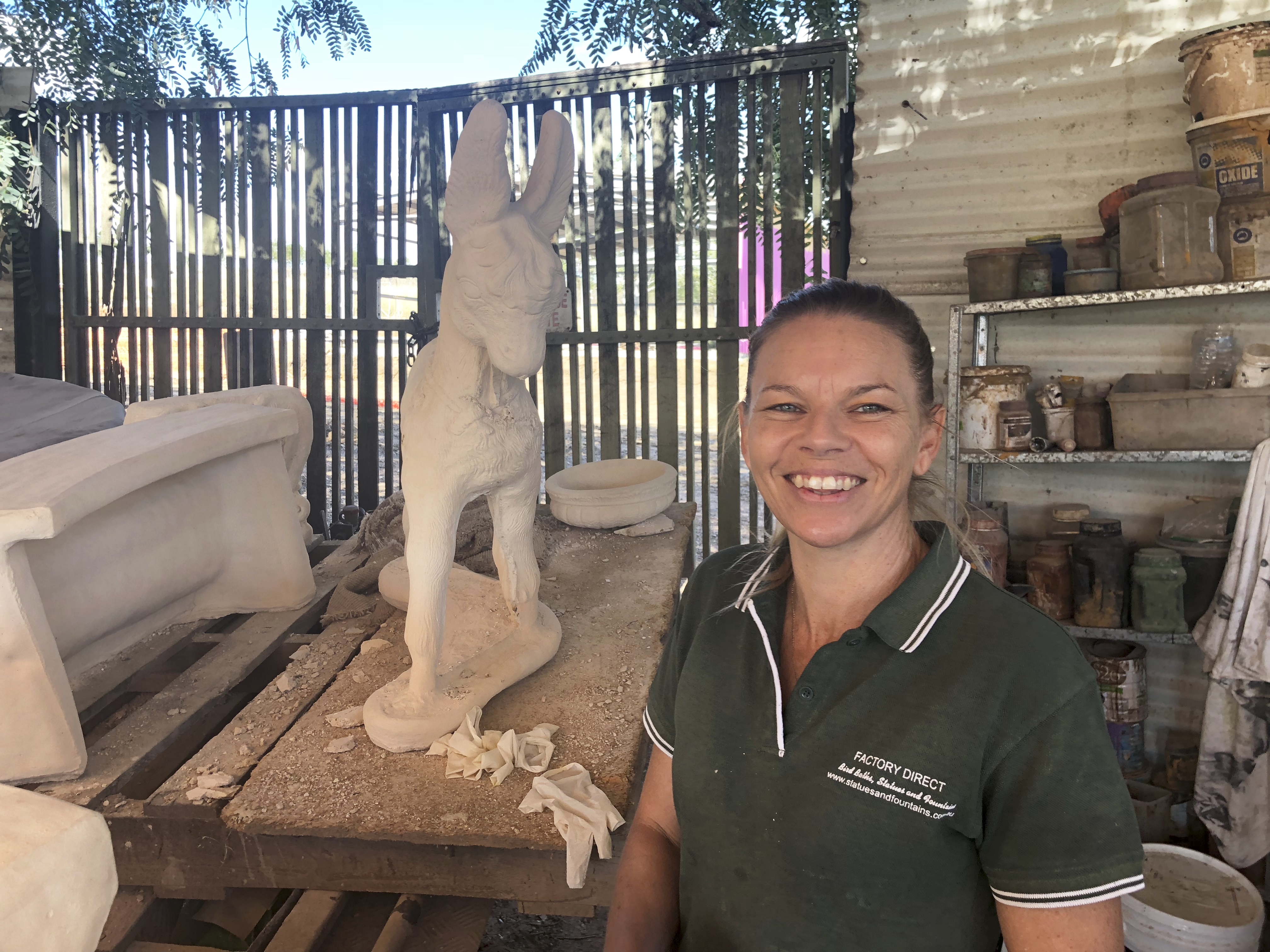
Leah · demoulding a Donkey Statue, Hatton Vale workshop 05Step five · demould and finish
The piece meets daylight
Pictured: Donkey Statue, fresh out of the mould.
At this stage the concrete is hard enough to handle but still soft enough to mark — so it gets lifted with care. Sharp edges are sanded back, any flashing from the mould seam is cleaned off, the surface is wiped down. The character details — those long ears, the cartoonish proportions, the texture across the back — get their final tidy-up here before the piece goes out to the yard.
-
Photo to come06
Step six · cure to full hardness
Two weeks in the yard
From the workshop floor a finished piece goes out to the yard for another fortnight of curing in open air. This is where most of the lime works its way out — the chalky white film you'll see in the first month at home is the tail end of the same process.
By the time a piece is loaded onto the truck for delivery, the concrete is hard enough to take a lifetime of weather. From there it's up to the garden — and your sealing schedule — to look after it.
Browse the studio.
Every piece in the collections was made the way you just read. Six steps, roughly seven days, two of us at the workshop in Hatton Vale.
All collections